
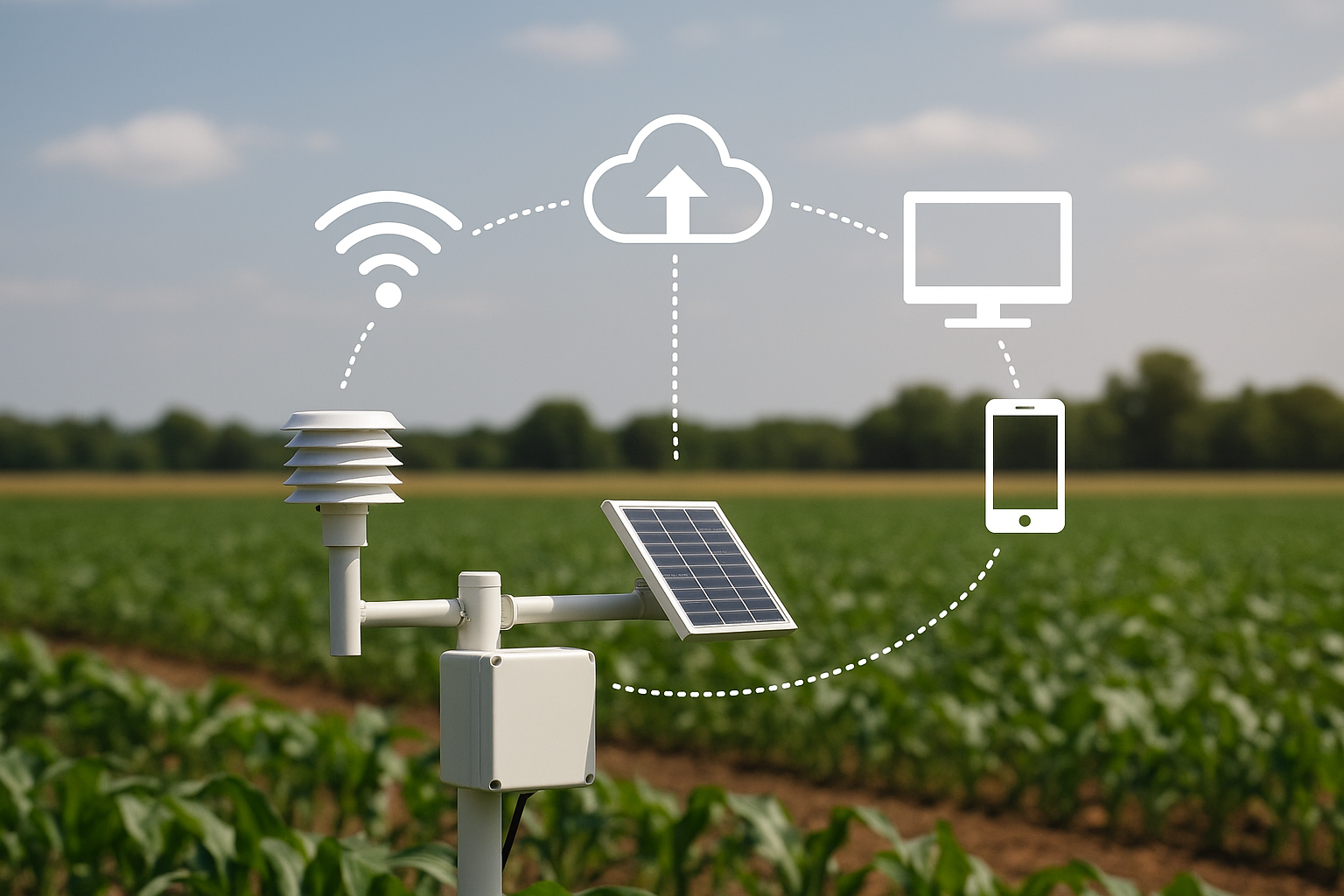
Another exciting concept I’ve come across in my master’s program so far is the Model Context Protocol (MCP). It’s a new way of thinking about how artificial intelligence connects and communicates with the many tools we use every day, like Gmail, Google Calendar, or other online networks. I’m thinking Ag sensor data.
I first encountered something like this while using n8n, an open-source workflow automation platform, for an assignment. I built a simple agent that could connect to OpenAI using an API, check a Google Calendar for meeting availability, book the meeting, and then send an email through Gmail confirming the event. The agent was able to complete all these steps based on a single chat message. The MCP understood which systems to use, in what order, and how the data needed to move between them.
A few years ago, I would have built something similar using a series of independent API calls. One to check the calendar, another to send an email, but those would be independent data movements with a user directing traffic. Each would require its own authentication, formatting, and error handling. This approach works and still does, but if one system changes, the whole thing could break. MCP is designed to solve this problem.
What Is MCP?
MCP (Model Context Protocol) was introduced by Anthropic and others in 2024 as an open standard for connecting AI systems to external tools and data. It’s like a universal adapter for AI agents. The analogy I was given was a digital USB-C plug that allows a workflow to plug into different technologies using a common interface instead of custom-built connectors for each one.
This approach helps solve what engineers call the “N × M integration problem.” When there are many models (like OpenAI, Claude, Gemini) and many tools (like Google Workspace, Slack, or custom databases), the number of possible connections between them grows exponentially. MCP gives all these systems a shared language so they can communicate without needing a new integration for each pairing.
In practice, it means an AI agent doesn’t just “call” a function but understands the context, like what tool is being used, what data it needs, and what to do next based on the results.
Why This Matters
With MCP, systems can begin to behave less like a set of isolated tools and more like a coordinated workflow. Instead of manually managing data between different platforms, the AI agent can orchestrate the process from end to end.
For example, imagine an MCP agent for a farm that:
- Reads soil-moisture and temperature data from Google Firestore
- Sends those readings to a large language model (like OpenAI or Claude) for interpretation
- Generates an irrigation or disease-pressure recommendation
- Emails a summary to the grower, including suggested next steps
The entire process could happen in near real-time, with the AI handling the logic of which systems to contact and when.
However, and this is important, the goal isn’t to remove humans from the loop. These systems are most effective when they serve as collaborators, not replacements. MCP enables well-designed workflows, not unchecked automation. Someone still needs to interpret the recommendations, confirm the actions, and make sure the AI’s assumptions align with real-world conditions.
Risks and Realities
As promising as MCP is, it raises legitimate questions about security, data privacy, and long-term compatibility.
When agents gain the ability to move data between tools automatically, who’s responsible for monitoring those actions? How do we ensure the schemas stay consistent when APIs evolve? And what happens when a model misinterprets a data point and the error propagates through multiple systems?
These are the challenges ahead for developers, educators, and practitioners experimenting with agentic systems. Building transparency, audit trails, and safeguards into every workflow will be essential.
Where This Could Go
The potential applications are enormous. In agriculture alone, MCP could link together environmental sensors, irrigation controls, and communication tools to create adaptive management systems that learn and respond over time.
It could also simplify how we teach and deploy technology in Extension by creating reusable connectors for common tasks like sending updates, analyzing soil data, or generating reports. Each new “tool” would just plug into the existing workflow instead of requiring a full redesign.
For me, MCP represents more than just a new technical standard but a shift in mindset. Instead of building one-off automations, we can begin to design systems that understand the flow of work itself, connecting data, decisions, and people in a seamless loop.
As with most ideas that I am studying, trust in the technology is the fulcrum for adoption. MCP is one of those ideas that feels both futuristic and deeply useful. The practitioners in the field unfamiliar with the systems must feel confident accepting the results of an agentic system built with MCP. I see my role as developing this confidence with stakeholders.